
What Is Land Acquisition? A Complete Guide for Beginners
Land is one of the most valuable assets in the world. Every residential township, industrial park, warehouse, solar power plant, data center, highway, or infrastructure project starts with one fundamental requirement —land.
However, identifying, evaluating, negotiating, and acquiring suitable land is often a complex process involving multiple stakeholders, legal considerations, documentation, and regulatory requirements. This entire process is known as land acquisition.
Whether you are a property investor, developer, business owner, farmer, or simply interested in understanding how large projects are developed, learning about land acquisition provides valuable insight into the foundation of real estate and infrastructure development.
What Is Land Acquisition?
Land acquisition is the process of identifying, evaluating, negotiating, and obtaining ownership or rights over land for a specific purpose.
The purpose may include:
· Residential development
· Commercial projects
· Industrial facilities
· Warehousing and logistics parks
· Infrastructure projects
· Renewable energy projects
· Data centers
· Forestry and environmental projects
· Agricultural activities
Simply put, land acquisition transforms land from a geographical parcel into an economic asset capable of supporting future development and value creation.
Why Is Land Acquisition Important?
Land acquisition is the first and one of the most critical stages of any development project.
Without suitable land, projects such as:
· Housing developments
· Industrial corridors
· Manufacturing plants
· Solar parks
· Logistics hubs
· Highways and railways
· Educational institutions
· Hospitals
cannot be executed.
Successful land acquisition helps ensure:
· Proper project feasibility
· Reduced legal risks
· Better investment returns
· Faster project execution
· Long-term appreciation potential
Types of Land Acquisition
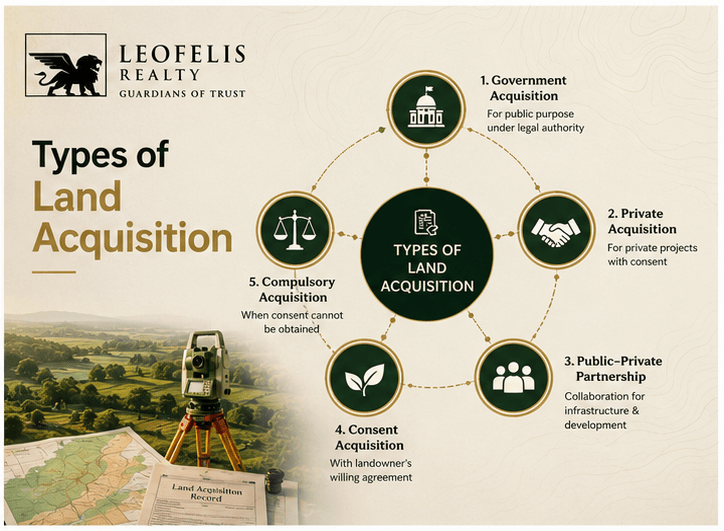
Land acquisition can broadly be classified into two categories.
1. Private Land Acquisition:
Private land acquisition involves transactions between private parties.
Examples include:
· A developer purchasing agricultural land.
· An industrial company acquiring land for a factory.
· Investors buying land for future appreciation.
Most real estate transactions fall under this category.
2. Government Land Acquisition:
Government agencies may acquire land for public purposes such as:
· Highways
· Railways
· Airports
· Metro projects
· Irrigation schemes
· Defense projects
In India, such acquisitions are governed primarily by the Right to Fair Compensation and Transparency in Land Acquisition, Rehabilitation and Resettlement Act, 2013.
Who Requires Land Acquisition Services?
Land acquisition services are used by various stakeholders, including:
1. Real Estate Developers
For residential townships, plotted developments, and commercial projects.
2. Industrial Companies
For manufacturing facilities and industrial expansion.
3. Warehousing and Logistics Companies
To establish logistics parks and distribution centers.
4. Renewable Energy Developers
For solar, wind, and green energy projects.
5. Infrastructure Companies
For roads, railways, and utility projects.
6. Institutional Investors
For long-term land banking and strategic investments.
7. Data Center Developers
To establish digital infrastructure facilities.
The Land Acquisition Process

Land acquisition is not a single transaction. It is a structured process consisting of several stages.
Step 1: Requirement Identification
The first step is understanding the project requirements.
Factors considered include:
· Location
· Area requirement
· Budget
· Zoning
· Infrastructure connectivity
· Future growth potential
Step 2: Site Identification
Potential land parcels are identified based on the project’s objectives.
Selection criteria may include:
· Accessibility
· Availability of utilities
· Proximity to highways
· Nearby industries
· Market demand
· Environmental factors
Step 3: Preliminary Evaluation
Before proceeding further, an initial assessment is conducted.
This includes:
· Ownership details
· Physical characteristics
· Topography
· Existing land use
· Encroachments
· Access roads
Step 4: Due Diligence
Due diligence is one of the most important phases.
It involves verification of:
· Title documents
· Record of Rights
· Mutation entries
· Encumbrances
· Land use classification
· Reservations and zoning restrictions
· Court disputes
· Government notifications
Proper due diligence minimizes legal and financial risks.
Step 5: Negotiation
Negotiations are conducted with landowners regarding:
· Price
· Payment structure
· Conditions of sale
· Possession timeline
In large projects involving multiple landowners, negotiations may require extensive stakeholder coordination.
Step 6: Documentation
Once terms are finalized, legal documentation is prepared.
This includes:
· Sale agreement
· Power of Attorney (if applicable)
· Stamp duty payment
· Registration formalities
Step 7: Registration and Transfer
Ownership is legally transferred through registration under applicable laws.
Revenue records are updated through mutation processes.
Step 8: Possession and Project Development
After completion of legal formalities, physical possession is taken and development activities begin.
What Is Land Aggregation?
Large projects often require land spread across multiple ownerships.
The process of consolidating several adjoining land parcels into a single larger parcel is called land aggregation.
Land aggregation plays a crucial role in:
· Industrial parks
· Warehousing projects
· Infrastructure developments
· Renewable energy parks
· Township projects
As land ownership in India is often fragmented, land aggregation requires careful coordination among multiple stakeholders.
Common Challenges in Land Acquisition
Although land acquisition creates tremendous opportunities, it also presents several challenges.
1. Fragmented Ownership
Large parcels are often divided among numerous owners.
2. Title Issues
Defective titles and unclear ownership can delay transactions.
3. Boundary Disputes
Survey discrepancies may create conflicts.
4. Regulatory Restrictions
Certain lands may be subject to zoning or environmental regulations.
5. Access Problems
Lack of approach roads may affect usability.
6. Encumbrances
Mortgages and legal claims can impact ownership transfer.
Importance of Professional Land Acquisition Advisory
Land transactions involve legal, technical, commercial, and social aspects.
Professional land acquisition advisory helps:
· Identify suitable opportunities.
· Conduct due diligence.
· Coordinate with stakeholders.
· Minimize transaction risks.
· Improve project timelines.
· Facilitate smoother execution.
Experienced consultants act as a bridge between landowners, developers, investors, and institutions.
Emerging Trends in Land Acquisition
The future of land acquisition is being shaped by several trends:
Industrial Corridors
Growing manufacturing investments are increasing demand for industrial land.
Warehousing and Logistics
E-commerce expansion is driving demand for logistics parks.
Renewable Energy
Solar and wind projects require large land parcels.
Data Centers
Digital infrastructure is creating new demand for strategically located sites.
ESG and Sustainability
Environmental and social considerations are increasingly influencing site selection.
Carbon Ready Land Aggregation
Land is gradually evolving into a platform for carbon projects, biodiversity initiatives, forestry programs, and nature-based assets.
Frequently Asked Questions
What is meant by land acquisition?
Land acquisition refers to the process of obtaining land ownership or rights for a specific purpose such as development, industrial use, infrastructure, or investment.
Why is land acquisition important?
Land acquisition provides the foundation for residential, industrial, commercial, and infrastructure projects.
What is the difference between land acquisition and land aggregation?
Land acquisition refers to obtaining land, while land aggregation involves combining multiple land parcels into one larger contiguous parcel.
What documents are important in land acquisition?
Important documents include:
· Record of Rights
· 7/12 Extract
· Mutation Entries
· Title Documents
· Encumbrance Certificates
· Survey Records
What are the biggest risks in land acquisition?
Major risks include:
· Defective title
· Encroachments
· Boundary disputes
· Zoning restrictions
· Legal disputes
Access issues
Conclusion
Land acquisition is far more than simply purchasing land. It is a multidisciplinary process involving legal verification, technical evaluation, stakeholder coordination, and strategic planning.
As urbanization, industrialization, renewable energy, and sustainability initiatives continue to reshape the economy, the importance of structured and professionally managed land acquisition is likely to increase significantly.
In the years ahead, concepts such as land aggregation, ESG-oriented development, and Carbon Ready Land Aggregation are expected to redefine how land assets are identified and utilized, creating new opportunities for developers, investors, institutions, and landowners alike.
About LEOFELIS REALTY
LEOFELIS REALTY is a land acquisition and real estate advisory platform focused on land sourcing, land aggregation, owner coordination, location intelligence, and transaction facilitation across Maharashtra.
With a long-term vision toward Carbon Ready Land Aggregation, ESG-oriented real estate, and nature-based assets, LEOFELIS REALTY aims to bridge traditional land expertise with the emerging opportunities of sustainable development.
GET A FREE CONSULTATION TODAY!


© LEOFELIS REALTY PRIVATE LIMITED